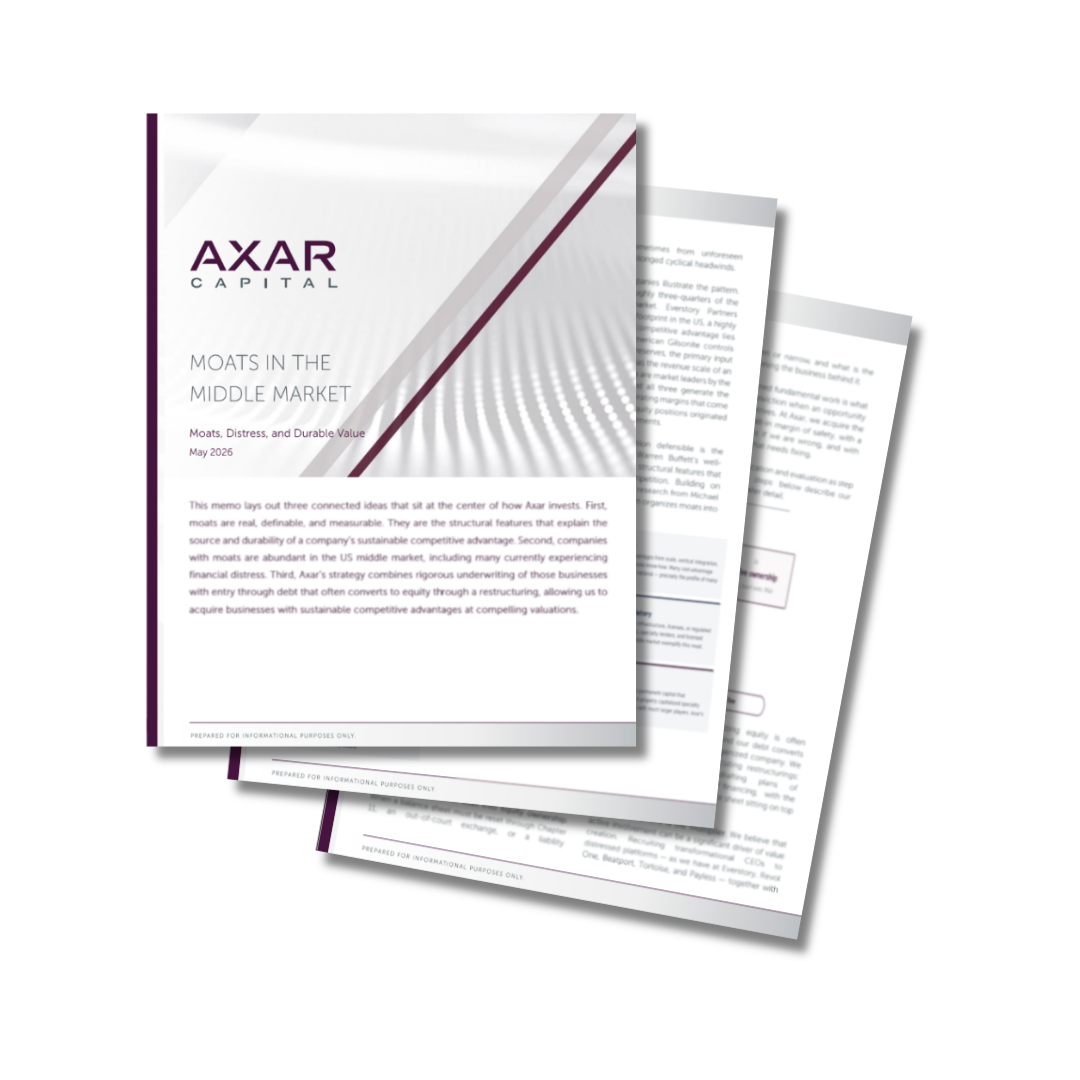
Moats in the Middle Market is not a market update. It's Axar's structured argument for why business quality has nothing to do with revenue scale, why dominant franchises are
disproportionately found in the US middle market, and how financial distress creates the entry point.
Five pages. Axar's framework for finding durable competitive advantage in middle-market distress.
Part I Defining Quality:
Why moats, not revenue scale, define business quality. The ten categories Axar uses to measure them.
Part II Why Good Businesses May End Up in Distress:
Structural factors that drive middle market dislocation, and why a significant portion of leveraged loans are held by forced sellers.
Part III The Axar Playbook:
Four steps from moat identification to active equity ownership, with illustrative examples from J.G. Wentworth, Everstory Partners, and American Gilsonite.
Axar Capital Management is a $3.3 billion opportunistic investment manager focused exclusively on U.S. middle-market companies in transition and distress. We don’t observe this market from the outside. We operate within it. This memo reflects our analytical frameworks informed by our investment experience. This memo reflects our actual analytical frameworks, not theoretical ones.
Focused exclusively on U.S. middle-market opportunities in transition and distress. Not a generalist mandate with a distressed sleeve.
Direct participation in restructurings across financial services, consumer, media, and industrials. The insights in this memo are drawn from live investments, not benchmarks.
100% employee-owned with a focused team of 6 investment professionals. The strategy is focused on investments aligned with the themes discussed in this memo.
Five pages. Axar's complete analysis of what makes a business genuinely defensible, where those businesses are found, and how distress creates the entry point.
This material is for informational purposes only, does not constitute an offer, reflects Axar’s views, and investing involves risk. Certain information contained herein has been obtained from third-party sources believed to be reliable, but has not been independently verified.